Release time:2026-09-26 14:34:59 browse:
A great paint job rarely depends on the paint alone. It depends on how you open the bucket, and how you stir it.
Meet the red paint can opener and the black perforated stirring stick — a pair that looks like throwaway extras
but delivers a clean handoff from leverage to fluid dynamics.
The Red Opener — 100:1 Leverage
Its job: break the seal. A properly sealed 5-gallon bucket holds roughly 50–80 N of vacuum plus rim friction.
Pry it with a screwdriver and you'll dent the rim, ruining the reseal.
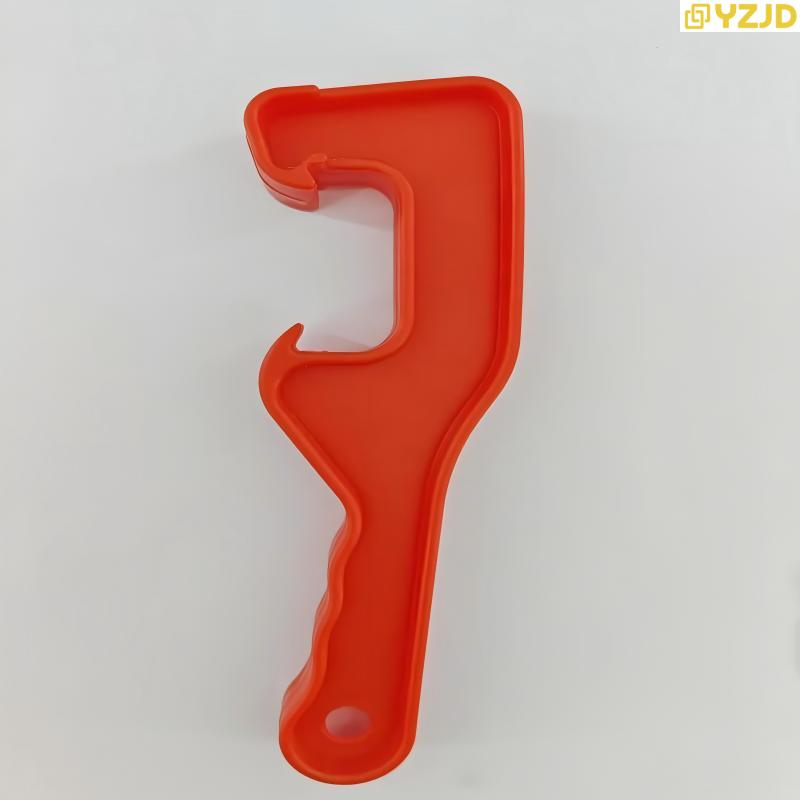
- Fulcrum: beak on the rim's top edge
- Load: tip in the lid gap
- Effort: your hand at the handle end
A ~20 cm handle against a ~2 mm resistance arm gives a mechanical advantage near 100:1. Two fingers produce
about 200 N of prying force. Work it around the rim in segments — attrition, not brute force.
The Black Stirrer — Seven Holes of Fluid Dynamics
Left standing, pigment settles into a hard "paint cake." Under-mixing means uneven color and patchy gloss.
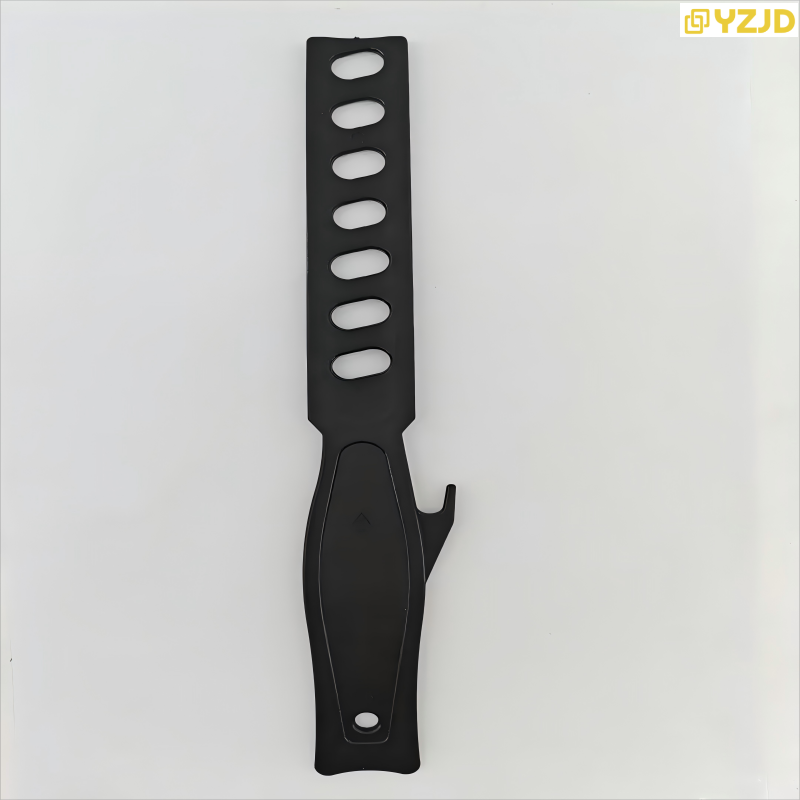
A solid stick just pushes liquid in a circle (bulk flow) — poor efficiency. Perforations change everything:
1. Shear flow — paint forced through the holes gets torn apart and recombined, breaking up agglomerates.
2. Micro-vortices — tiny eddies behind each hole create multi-directional turbulence with no dead zones.
3. Drag reduction — less frontal resistance, so high-viscosity latex won't tire your arm.
Why seven?
Bucket depth is 17–20 cm; the 27 cm stick leaves 7–8 cm for grip. Seven holes cover every layer from bottom
to surface while keeping the body strong.
Why Engineering Polymer?
Requirement | Benefit |
Protect the container | No dented rims, no scratched liners |
Chemical resistance | Won't swell or dissolve in solvents and thinners |
Spark-free safety | Non-conductive, no friction sparks around solvent-based coatings |
Red for visibility in a cluttered toolbox; black to hide stains on dark jobs.
One Closed-Loop Workflow
Open → Mix → Apply → Reseal (C-hook presses the lid home)
No extra tools. No metal. No training. Good industrial design is invisible — it just works.
The best science isn't always in a lab. Sometimes it's in your toolbox.


 English
 Spanish